- Welcome to Pulse Robot
- +86-23-63207381
- +8613677602178
- sales@pusirobot.com

AMR Robot Solutions
AMR Robot Solutions
Abstract
In warehousing and logistics, flexible production lines, factory inspection, and other applications, light- to medium-payload autonomous mobile robots (AMRs) have become widely adopted. Many equipment makers still use traditional entry-level servo or separate stepper drive solutions. In real deployments, however, these solutions often face high cost, crowded chassis space, low-speed jitter, stall damage, and complex tuning. PUSIROBOT integrated stepper motors support torque mode, 4,000 rpm high-speed operation, and multiple safety protections. By looking at core AMR scenarios such as chassis travel, steering-wheel steering, and mechanism lifting, this article shows the solution’s replacement value and practicality for light AMRs. It gives robot makers a new selection approach to cut costs, improve efficiency, and optimize equipment stability.
I. Current Pain Points of Light- to Medium-Payload AMRs
Most light AMRs on the market (100–500 kg payload class) use entry-level servo or ordinary separate stepper motor solutions. Both have clear weaknesses and cannot meet the needs of lightweight, highly stable, low-cost mass production.1. Entry-level servo solutions offer poor value
The separate setup includes a motor and an independent driver, leading to high material and assembly costs. For light-to-medium payloads, they are overkill. Entry-level servos also commonly suffer from low-speed jitter and tedious parameter tuning, resulting in high field failure rates.
2. Ordinary open-loop/closed-loop steppers have major limitations
Traditional stepper motors cannot hold constant torque. Under load changes or during lifting and pressing, they may slip or lose steps. Their speed ceiling is low, torque drops sharply at high speed, and they lack complete safety protections. Under vibration or jamming, they can easily damage equipment.
3. Separate designs fit poorly
With the motor and driver separated, chassis wiring is complex and takes up space. This increases assembly time and failure risk, and severely limits compact, lightweight AMR chassis design, making upgrades harder.
II. Core Advantages of PUSIROBOT Integrated Stepper Motors (Designed for AMRs)
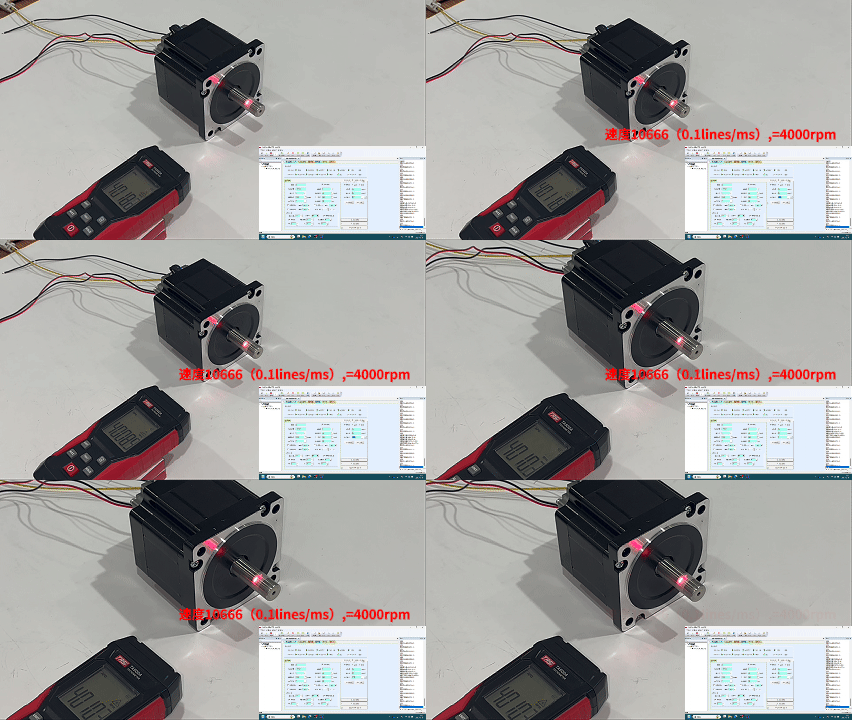
To address the pain points of traditional drive solutions, we have optimized and upgraded our product: an integrated stepper motor with torque control mode, 4,000 rpm high speed, and built-in triple safety protection. It fits the full range of light-to-medium-payload AMR applications, fills the gaps of traditional steppers, and can fully replace entry-level servo solutions.
1. Dual control modes for complex working conditions
Unlike ordinary stepper motors that only support position control, this motor adds an independent torque mode for constant torque output. It is ideal for AMR lifting and pressing, steering-wheel ground contact, and flexible collision protection.
2. 4,000 rpm high-speed operation with no power drop-off
It breaks the low-speed limitation of traditional steppers and supports stable operation up to 4,000 rpm. At high speed, torque decay is small and response is fast. This meets AMR needs for fast transfer, quick mechanism reset, and high-frequency start-stop, greatly improving equipment efficiency.
3. Triple hardware protection for stable 24/7 operation
Built-in stall protection, overcurrent protection, and overtemperature protection automatically detect, warn, and shut down in response to common AMR issues such as obstacle jams, overload, and high temperature from long working hours.
4. Highly integrated design for simple installation and maintenance
The motor body, drive module, and encoder feedback system are integrated into one unit. No extra driver is needed, greatly simplifying chassis wiring and saving internal space.
Unlike ordinary stepper motors that only support position control, this motor adds an independent torque mode for constant torque output. It is ideal for AMR lifting and pressing, steering-wheel ground contact, and flexible collision protection.
2. 4,000 rpm high-speed operation with no power drop-off
It breaks the low-speed limitation of traditional steppers and supports stable operation up to 4,000 rpm. At high speed, torque decay is small and response is fast. This meets AMR needs for fast transfer, quick mechanism reset, and high-frequency start-stop, greatly improving equipment efficiency.
3. Triple hardware protection for stable 24/7 operation
Built-in stall protection, overcurrent protection, and overtemperature protection automatically detect, warn, and shut down in response to common AMR issues such as obstacle jams, overload, and high temperature from long working hours.
4. Highly integrated design for simple installation and maintenance
The motor body, drive module, and encoder feedback system are integrated into one unit. No extra driver is needed, greatly simplifying chassis wiring and saving internal space.
III. Key Application Scenarios
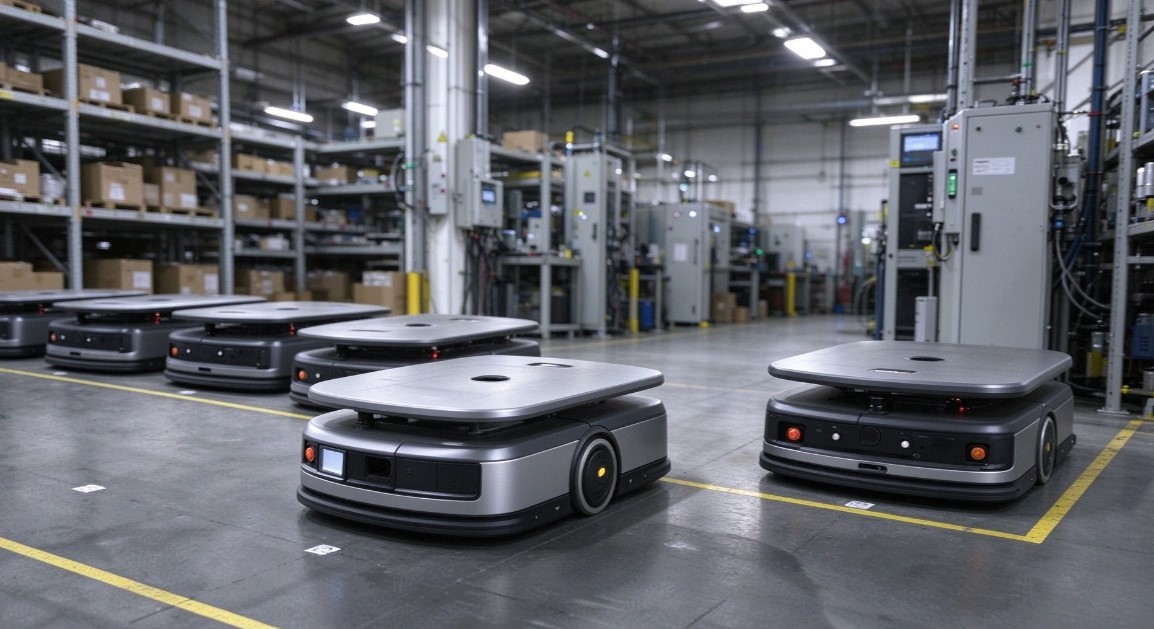
1. AMR material lifting mechanism
With dedicated torque mode, the mechanism can press with constant torque after lifting into place, effectively preventing pallets from slipping or shifting. If material jams or overload occurs, stall and overcurrent protection trigger immediately, preventing structural cracking and motor burnout. This suits high-frequency lifting in warehouse AMRs.
2. Steering-wheel AMR steering drive
With 3,000 rpm high-speed response, it meets the robot’s needs for fast steering and in-place direction changes. At low speed, there is no jitter, and closed-loop control ensures accurate steering angles and prevents position drift. Its compact integrated structure fits compact steering-wheel modules and simplifies design.
3. Light AMR chassis travel drive
It works with the mainstream 24 V robot power supply, runs stably at high and low speeds, and starts and stops smoothly without shock. For long continuous operation, overtemperature and overcurrent protection keep conditions stable. It suits long-hour, high-frequency handling and inspection in factories, with a far lower failure rate than entry-level servo solutions.
With dedicated torque mode, the mechanism can press with constant torque after lifting into place, effectively preventing pallets from slipping or shifting. If material jams or overload occurs, stall and overcurrent protection trigger immediately, preventing structural cracking and motor burnout. This suits high-frequency lifting in warehouse AMRs.
2. Steering-wheel AMR steering drive
With 3,000 rpm high-speed response, it meets the robot’s needs for fast steering and in-place direction changes. At low speed, there is no jitter, and closed-loop control ensures accurate steering angles and prevents position drift. Its compact integrated structure fits compact steering-wheel modules and simplifies design.
3. Light AMR chassis travel drive
It works with the mainstream 24 V robot power supply, runs stably at high and low speeds, and starts and stops smoothly without shock. For long continuous operation, overtemperature and overcurrent protection keep conditions stable. It suits long-hour, high-frequency handling and inspection in factories, with a far lower failure rate than entry-level servo solutions.
IV. Summary
For light-to-medium-payload AMRs, blindly choosing entry-level servos only leads to overkill, inflated cost, and poor stability.
PUSIROBOT integrated stepper motors combine 4,000 rpm high-speed performance, constant torque control, triple safety protection, an integrated minimalist structure, and high cost-effectiveness. In core AMR travel, steering, and lifting scenarios, their performance fully matches—and can even exceed—entry-level servo solutions. They meet the need for high precision and high stability while helping manufacturers significantly cut costs and improve efficiency. They are currently the best replacement choice for motion control in light AMR robots.