- Welcome to Pulse Robot
- +86-23-63207381
- +8613677602178
- sales@pusirobot.com

Application of High-Precision Filling Valves
Application of Pusi Closed-Loop Stepper Integrated Units for Lightweight,
High-Precision Servo Filling Valves in Food
and Daily Chemical Filling Equipment
Abstract
Multi-head filling machines in the food and daily chemical industries mainly perform metered filling of beverages, condiments, laundry detergent, sauces, and other materials. As products change faster, machines must handle materials with different viscosities. This places higher demands on the flexible control of filling valves. The filling unit includes these core components:
- Servo filling valve assembly: Switches material flow on/off. A closed-loop stepper mechanism drives the valve spool up and down. Changing the spool opening changes the material flow. This is the core actuator of the filling equipment.
- Drive control unit: Outputs motion commands and controls the full valve action sequence: pre-open, full-open, slow-close, and suck-back. This solution uses the Chongqing Pusi closed-loop stepper integrated unit, which integrates the drive, controller, and encoder.
- Sensing components: Bottle-in-position and bottle-present detection signals, used to trigger the filling process.
- HMI unit: Recipe parameter setup, running status monitoring, and fault alarm output.
① Challenge: Traditional PLC + external drive solutions use many components, require complex cabinet wiring, and take long to commission.
To control multi-head filling valves, traditional solutions need an independent drive for each filling valve, with a PLC handling motion coordination. For an 8-head filling machine, the control cabinet contains a PLC, multiple external drives, many terminals and cables. Assembly and wiring take time, and on-site maintenance and troubleshooting are difficult. For small and medium-sized machine builders, hardware purchase costs and engineering commissioning requirements are both high.
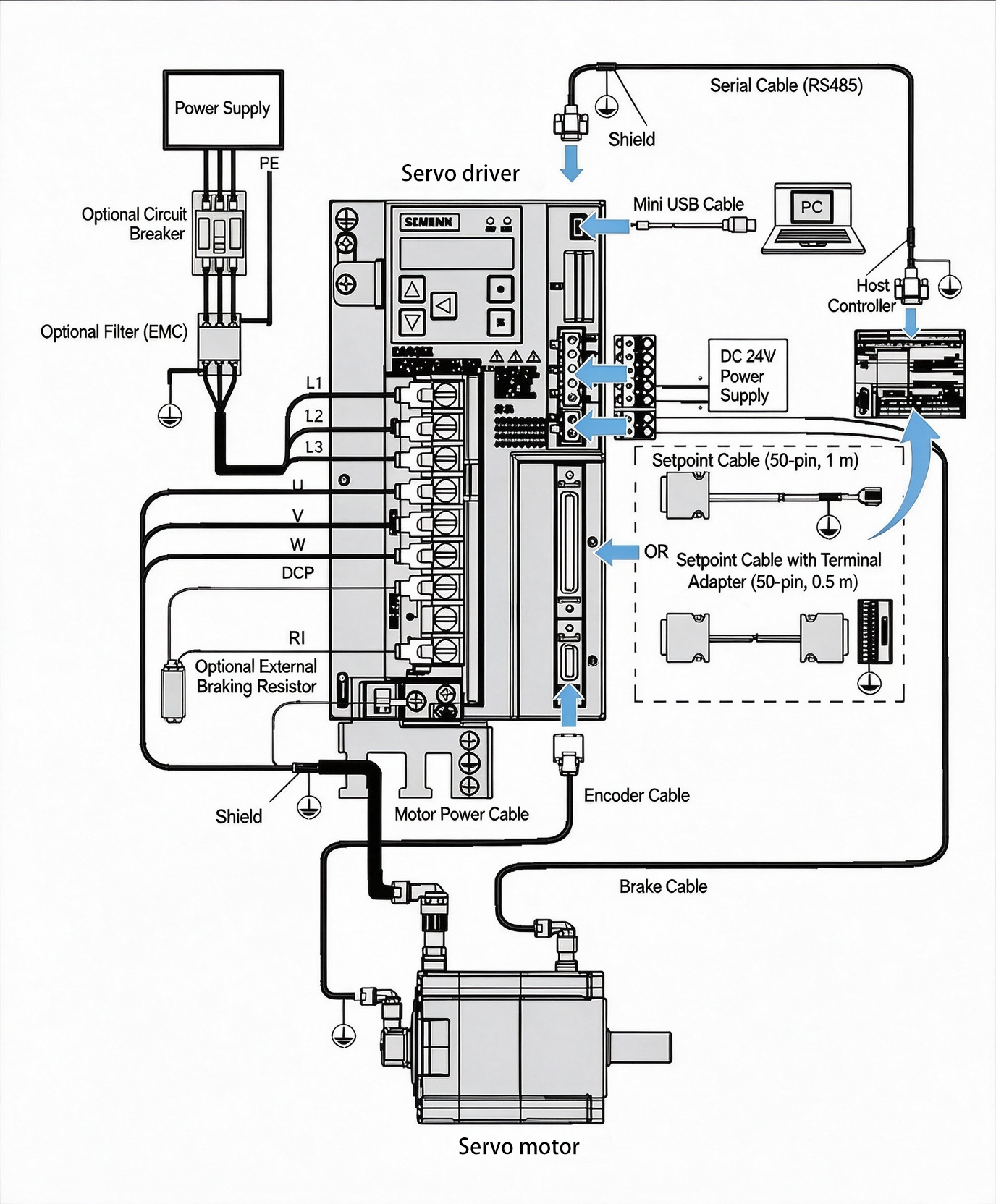
Solution: The Pusi closed-loop stepper integrated unit combines drive, control, and encoder in one unit, simplifying the electrical architecture.
The Pusi unit integrates the stepper drive, motion control unit, and encoder in a single device. One unit directly drives one filling valve actuator, so no separate external drive is needed.
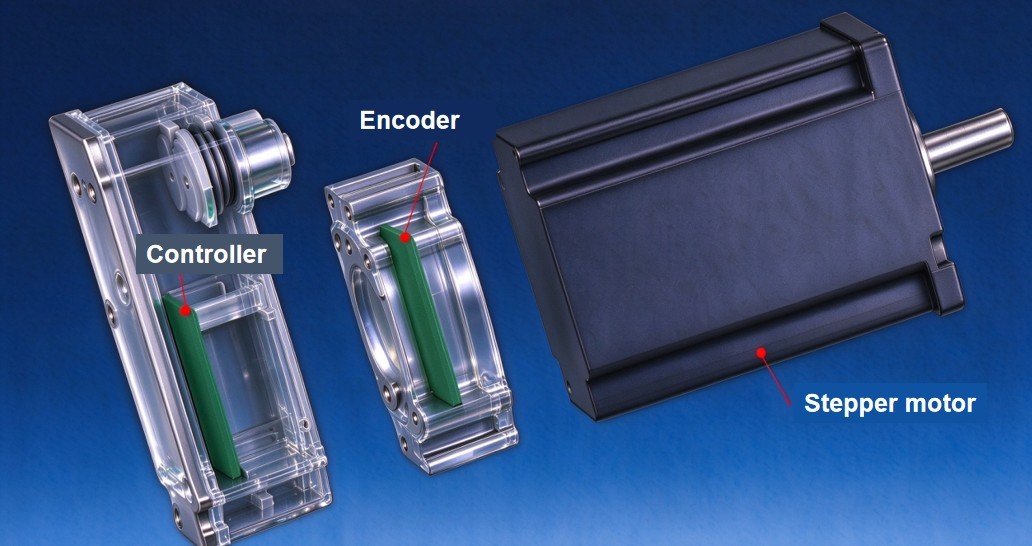
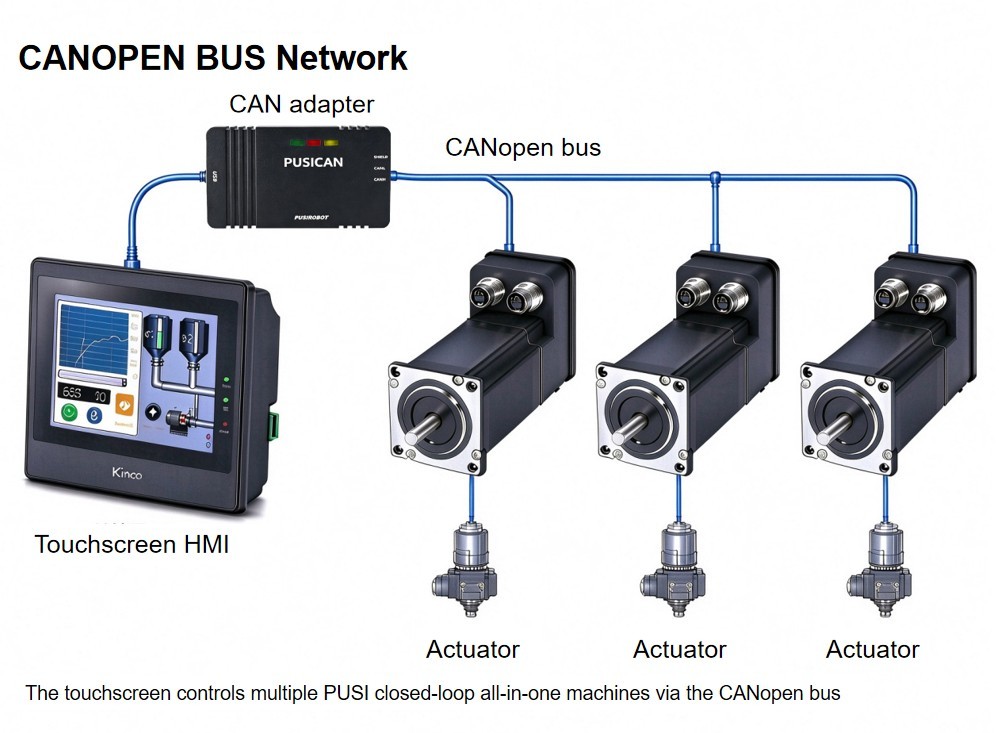
For an 8-head filling machine: the traditional solution needs 1 PLC + 8 external drives. With Pusi integrated units, only an HMI touchscreen + 8 Pusi units are needed, with no external drive modules. The number of components in the control cabinet is greatly reduced, wiring workload can drop by about 40%, and the cabinet can be made smaller.
② Challenge: Filling valve flow cannot be finely controlled in stages, causing foaming, dripping, and stringing, with poor filling repeatability.
Different materials have different problems. When filling low-viscosity liquids, if the spool opens fully, the material hits the bottle bottom and creates many bubbles, increasing actual fill-volume deviation. For high-viscosity sauces and detergents, material can string or drip at the bottle mouth at valve closing, contaminating bottles and the conveyor line. Traditional pneumatic filling valves have only two states: fully open and fully closed. The spool opening cannot be adjusted continuously. Conventional open-loop stepper solutions struggle to achieve a multi-stage flow profile—pre-fill, main fill, slow close, and suck-back—and may lose steps. With PLC real-time calculation and output, communication delay can also easily disturb the spool motion profile.
Solution: Motion sequences are built into the integrated unit for closed-loop, staged flow control of the valve spool.
The Pusi integrated unit supports point-to-point motion and storage of multi-segment trajectory sequences. The whole filling action—pre-open at small flow → main fill at large opening → final slow close → valve-close suck-back and reset—is stored locally in the unit. The HMI touchscreen only sends a trigger signal and does not take part in real-time motion calculation. This avoids motion distortion caused by bus communication delay.
- Pre-fill stage: The spool opens slightly for low-flow feeding, reducing liquid impact and suppressing foaming.
- Main fill stage: The spool moves to the set maximum opening for fast, high-flow feeding to maintain machine capacity.
- Final slow-fill stage: The spool opening is reduced to lower material flow speed and improve dosing repeatability.
- Valve-close suck-back stage: The spool closes quickly while suck-back is performed to eliminate stringing and dripping of viscous materials.
Stroke, speed, and acceleration/deceleration parameters for different viscosity materials are stored as recipes. When switching products, the matching parameters are recalled directly; no motion program rewrite is needed. Under actual operating conditions, filling repeatability for common materials can be within ±1%, meeting production targets in the food and daily chemical industries.
③ Challenge: Multi-head filling valves are difficult to synchronize; stations have timing deviations, and fill-volume consistency across heads is poor.
On multi-head filling machines, multiple filling valves work at the same time. With traditional PLC control of multiple external drives, PLC scan cycles and bus delay cause time differences in spool start and valve closing. This leads to inconsistent fill volumes between stations. A single valve fault can also affect the whole filling group.
Solution: CANopen distributed bus control and independent closed-loop control for each filling valve ensure synchronization and fault tolerance.
Multiple Pusi integrated units connect to the same CANopen bus network and receive synchronized trigger commands from the HMI. Each unit performs closed-loop motion control locally and independently.
- With synchronized triggering, valve action timing consistency is high, reducing fill-volume variation across stations.
- In the distributed architecture, if one integrated unit or one filling valve has an overload or stall fault, it can alarm and stop individually. Other filling stations can continue running, so the whole machine is not directly interrupted.
- The unit feeds back spool position, motor load, and fault codes to the touchscreen in real time, helping engineers quickly locate valve sticking and overload problems.
④ Challenge: On-site commissioning takes long and requires strong motion-control programming skills.
Traditional solutions require complex motion logic in the PLC. When debugging foaming or dripping on site, engineers must repeatedly modify the PLC program. Changeover commissioning takes a lot of time and requires high programming skills from commissioning staff.
Solution: PC commissioning software and HMI parameter configuration lower the commissioning barrier.
The Pusi integrated unit supports companion PC commissioning software, allowing real-time viewing of the spool position-time motion curve. If foaming or dripping occurs during on-site debugging, engineers can directly change stroke, speed, and acceleration/deceleration parameters. Parameters are saved directly to the integrated unit; no program changes are needed. Machine builders can package the entire filling process into parameter pages. On-site operators only need to change numbers to complete material changeover commissioning, reducing the programming-skill requirement for commissioning staff.