- Welcome to Pulse Robot
- +86-23-63207381
- +8613677602178
- sales@pusirobot.com

Practical Use of Stepper Motors in High-Speed
Practical Use of Stepper Motors in High-Speed Panel Edge Banding Machines
Many custom furniture factories share the same problem: a new edge bander is very accurate, but after running in mass production for a while, process stability keeps dropping. Narrow panels drift, ends come out uneven, glue lines look inconsistent, and some areas bond poorly or bubble. The industry often blames panels, glue, or tooling, but overlooks a hidden core issue: under high-speed production, motion control becomes unstable, position errors are hidden, and zero-point drift accumulates. Automatic edge banding is a system process. Most frequent defects come from three core problems: poor synchronization, unstable pressure, and inconsistent parameters. Closed-loop stepper motors with encoder feedback and a high-speed high-torque mode can directly address these three process gaps. They are now a cost-effective upgrade for edge banding equipment.
1. Limits of Traditional Motion Control
At the high-speed mass production demand of 25–32 m/min, traditional motor solutions show growing limitations:- Open-loop stepper motors: No position feedback. Dust, machine vibration, and panel impact can cause hidden lost steps. Errors keep accumulating, leading to frequent adjustment and batch-to-batch accuracy swings.
- Servo motors: Excellent dynamic accuracy, but most edge bander stations only need point-to-point adjustment and intermittent short-time loads. They do not need ultra-high dynamic response. Full servo upgrades cost too much and add more performance than needed for many small- and medium-batch production scenarios.
2. Core Advantages of the 006 Series Closed-Loop Stepper (Process Fit)
1) Full encoder closed-loop feedback prevents hidden lost-step accumulation.
The encoder compares actual motor position with commanded position in real time. Small deviations during operation are corrected immediately. If jamming or overload occurs, the system actively alarms and stops instead of “running while faulty,” ensuring long-term stable accuracy in mass production.2) High-speed high-torque controllable mode fits high-speed mass production.
Unlike ordinary stepper motors, whose torque drops sharply at high speed, the 006 Series high-speed torque mode automatically adjusts its operating state based on load changes. It dynamically balances speed and output capability.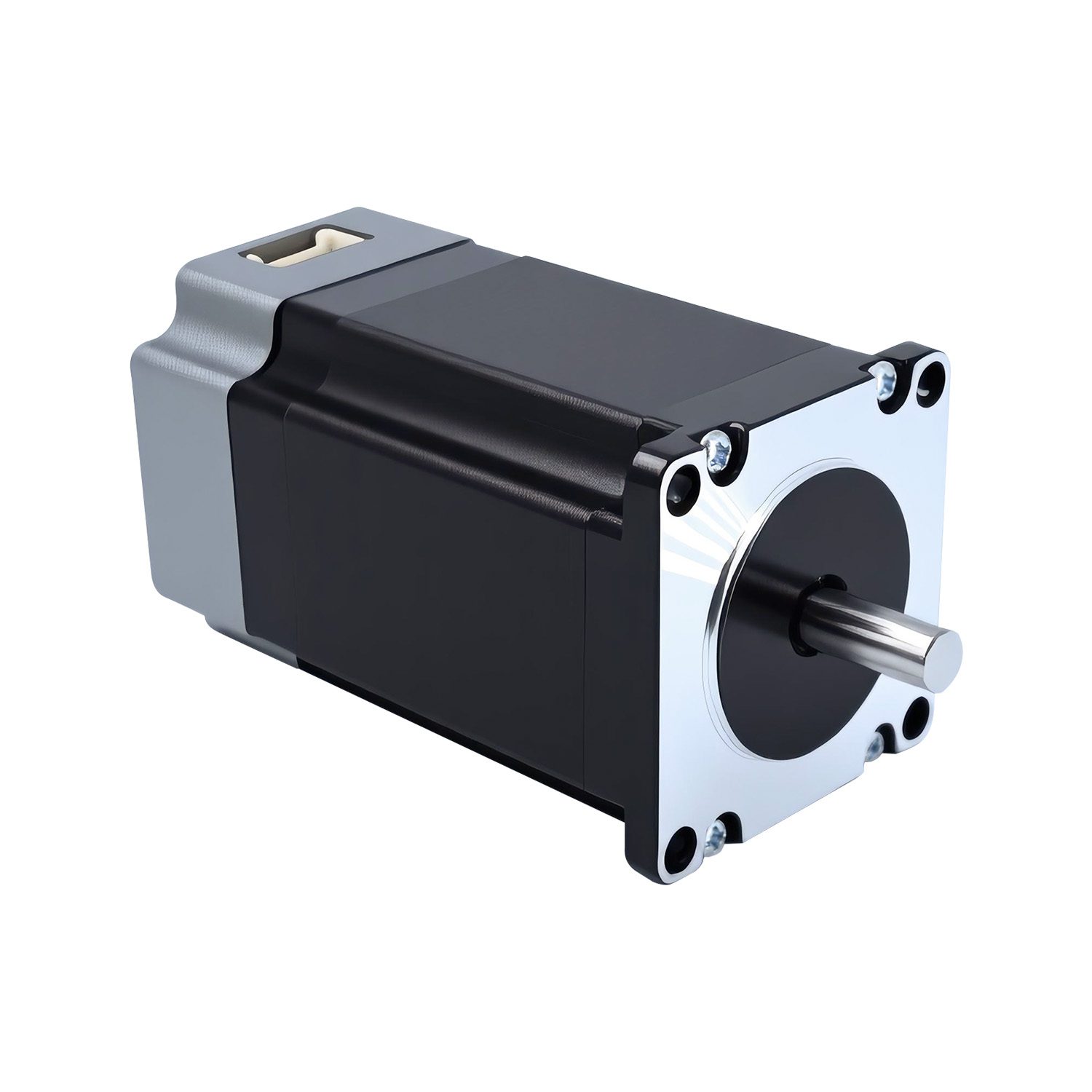
3) Idle-hold auto-correction keeps positioning references from being knocked out of place.
When the motor is stopped and holding, the encoder keeps monitoring actual position. If external force—such as panel impact or machine vibration—causes a shift, the system immediately drives the motor back to the target position before the shift. This is like adding an “electronic lock” to the positioning mechanism. Reference parts such as end-trimming cutter holders, feed stops, and width-adjusting rails need no manual reset after being hit, so position consistency is maintained over time. This directly improves the common industry complaint: ‘accurate when new, increasingly off after use.’